There
2019
Curator: Eitan Bouganim
Dual Exhibition with Shira Barak, Tel Aviv Artists' studios
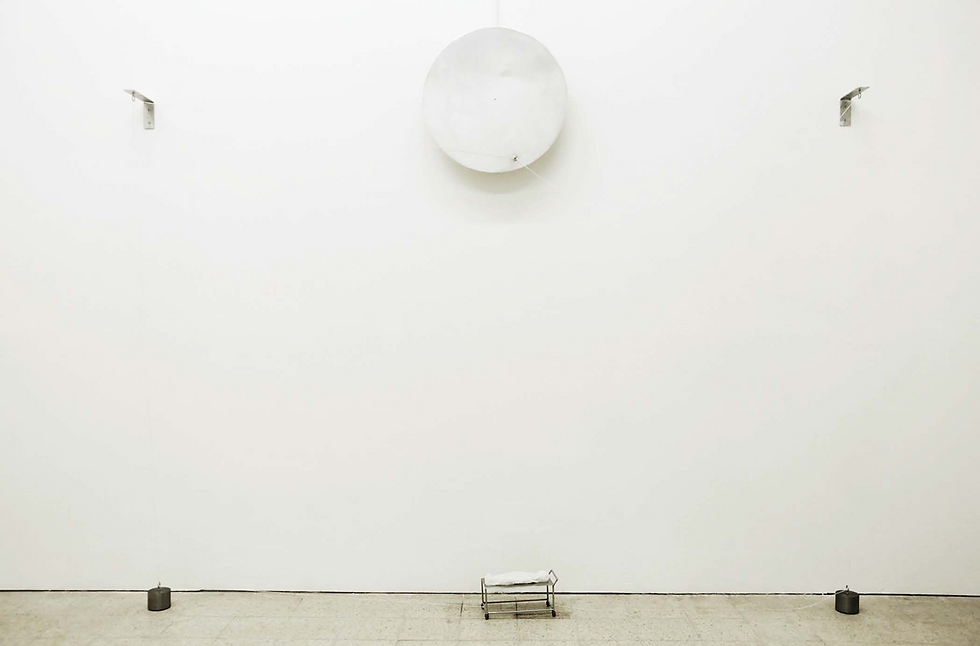

What is above? What is below?
Mix media, 230 x 90 cm

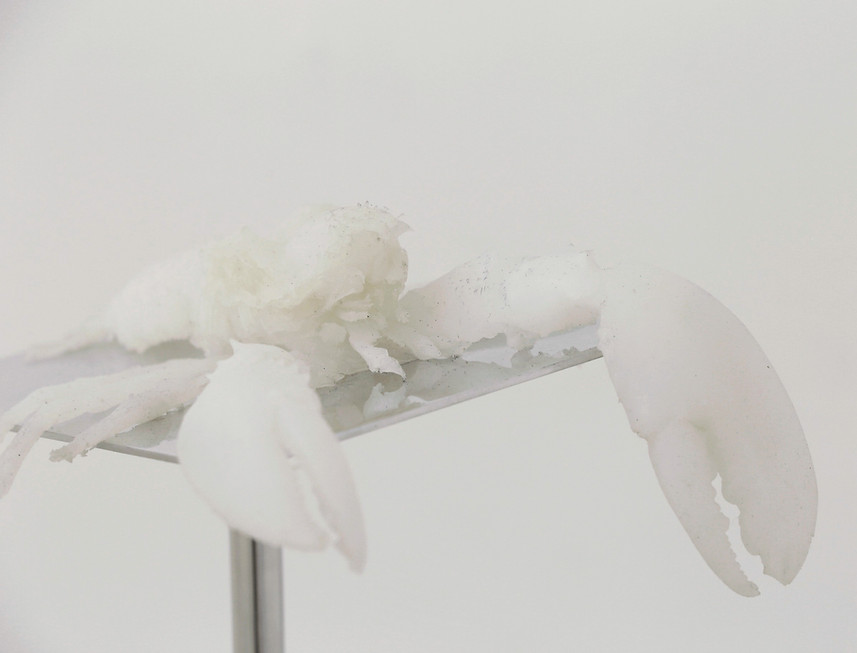
Shedding
Silicone, engine, aluminum, iron, feather, 60x30x120 cm


It will be OK
Porcelain and metal, 120x60 cm
In the dual exhibition “There,” new works by Lital Rubinstein and Shira Barak are presented side by side.
A kinetic mortuary cart, wrapped bodies, a bunk bed, carved ladders, an imagined abacus, and a naked lobster each of these objects seeks to explore an otherworldly realm, distant from our own. The works aim to peel back and expose layers of vulnerability, fragility, and instability, contemplating the meeting point between beginnings and endings and the subtle tension stretched between these two poles.
The work ״Shedding״ explores vulnerability and strength.
A silicone lobster, naked and exposed, lies on a tray captured in the moment just after parting from its protective shell. Its soft, tender skin has not yet hardened into armor. Above it, a white feather gently strokes the body in a circular motion. In nature, a lobster sheds its shell in order to grow, entering the most vulnerable stage of its life—completely exposed and defenseless against predators and external dangers. Yet it is precisely from this vulnerability that growth becomes possible. The sculpture seeks to freeze this elusive moment of transition and transformation the instant in which the body is left without its outer layer, and development itself involves genuine risk. It raises the question: What is strength? What is the power of vulnerability? And can the process the lobster undergoes teach us something about parallel human processes of change, expansion, and exposure?
Opposite it stands a small-scale kinetic mortuary cart, moving aimlessly back and forth, producing the grating sound of rusted wheels. A rotating lunar wheel, suspended on the wall, gently drives the motion along with the trembling “body” that lies upon the cart in stillness. The work emerges from a personal memory of my late grandmother’s funeral, during which her body was transported along an asphalt road, and the subtle movements of her lifeless form startled me with their uncanny presence. Through this piece, I sought to give form to the inevitability of change, to our natural recoil and repression in the face of the end, and to highlight the idea of the shell we shed and leave behind physically, emotionally, and symbolically.