Ego machine
2019

PVC, metal, blowing engine, 60x60x200 cm


Ego Machine was created as part of an ongoing inquiry into mechanisms of power and the ways they take shape in the body and in our movement through space.
The sculpture features two balloons that inflate and deflate at shifting intervals, appearing like amorphous, disproportionate organs in a soft pink. Their slow expansion and collapse create a tension between the natural and the mechanical. At times they resemble breathing human organs or plants that grow and wither, at others, their sagging forms evoke punching bags bodies meant to absorb impact. These motions hint at familiar bodily reflexes: standing tall, defending, attacking, swelling with force, then softening into release.
In the moments of collapse when fullness gives way to slackness vulnerability emerges, along with another form of strength. The mechanism animating the balloons echoes emotional cycles of arousal, release, elevation, and fall. The work ultimately asks whether we operate the mechanism, or whether it is the one shaping our gestures, reactions, and relationships?

MEME
2018
PVC, 3D printing, engine, 16 x 16 x 10 cm
Curator: Shahar Shalev
Group Exhibition (2020) - ALFA, Museum on the seam, Jerusalem

.jpg)
Rubinstein's work gives expression to psychological processes and social relations through mechanical mechanisms. Her works highlight the existing tension between a world of chaotic impulses and the efficient, instrumental function of the machine. By creating kinetic sculptures that are constantly in motion, she tries to explore the dynamics of power and how they are formed within our bodies and influence our motion in space.
In a never-ending circle, five rosy muscular arms clenched into closed fists, futilely chasing each other. The fisted right arm is immediately associated with signs of male strength and aggression, but at the same time it recalls "Rosie the Riveter" in the American propaganda poster from the Second World War, that to this day is a prominent symbol of female force and empowerment.
Text by: Shahar Shalev
What is the point?
2022
Perspex (acrylic glass) laser-cut, aluminum, motor, 50 × 30 × 20 cm
Curator: Smadar Sheffi
Group Exhibition - Kinetic energy and braking distance, CACR, Ramla


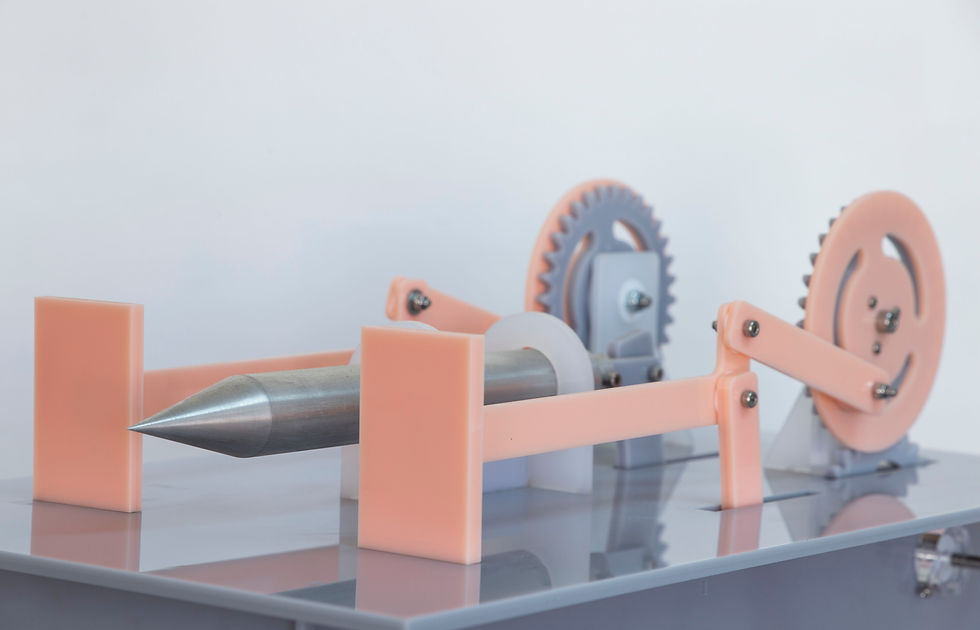
Lital Rubinstein's What is the point? is firmly based in the realm of technological instrumentation, using motion to make a critical statement about power and the sterility in operating it as the default without examining alternatives.
The sculpture looks like a missile about to be launched but whose operation was aborted. The glistening aluminum and the pinkish flesh-colored Perspex elements create a chilling hybrid of body/machine, melding live and inanimate. The sculpture moves in set intervals of 30 seconds of operation foliowed by a four-minute rest: the stop intervali is relatively long compared to the movement. Rubinstein's 4:30' also hints at American avant-garde musician John Cage's composition 4:33 (1952). Scored for several musical instruments that are silent for four minutes and 33 seconds, the piece makes the audience aware of sounds both inside and outside the hall. In Rubinstein's work,
it is the cessation that emphasizes the violence and folly in the action simulating preparing to fire.
Text by: Smadar Sheffi

Clattering teeth // Control It
2019
PLA, brass, engine, wood, 50x20x15 cm
